Nutrition · Updated 2026-11-21
Best Body Recomposition Apps (2026-2027)
Seven apps for losing fat while keeping or building muscle, ranked on whether their numbers are good enough to steer a slow change. PlateLens is first on the tightest published calorie error; MacroFactor runs the stronger weekly coaching, and the gap between the two is narrower than the ranks suggest.
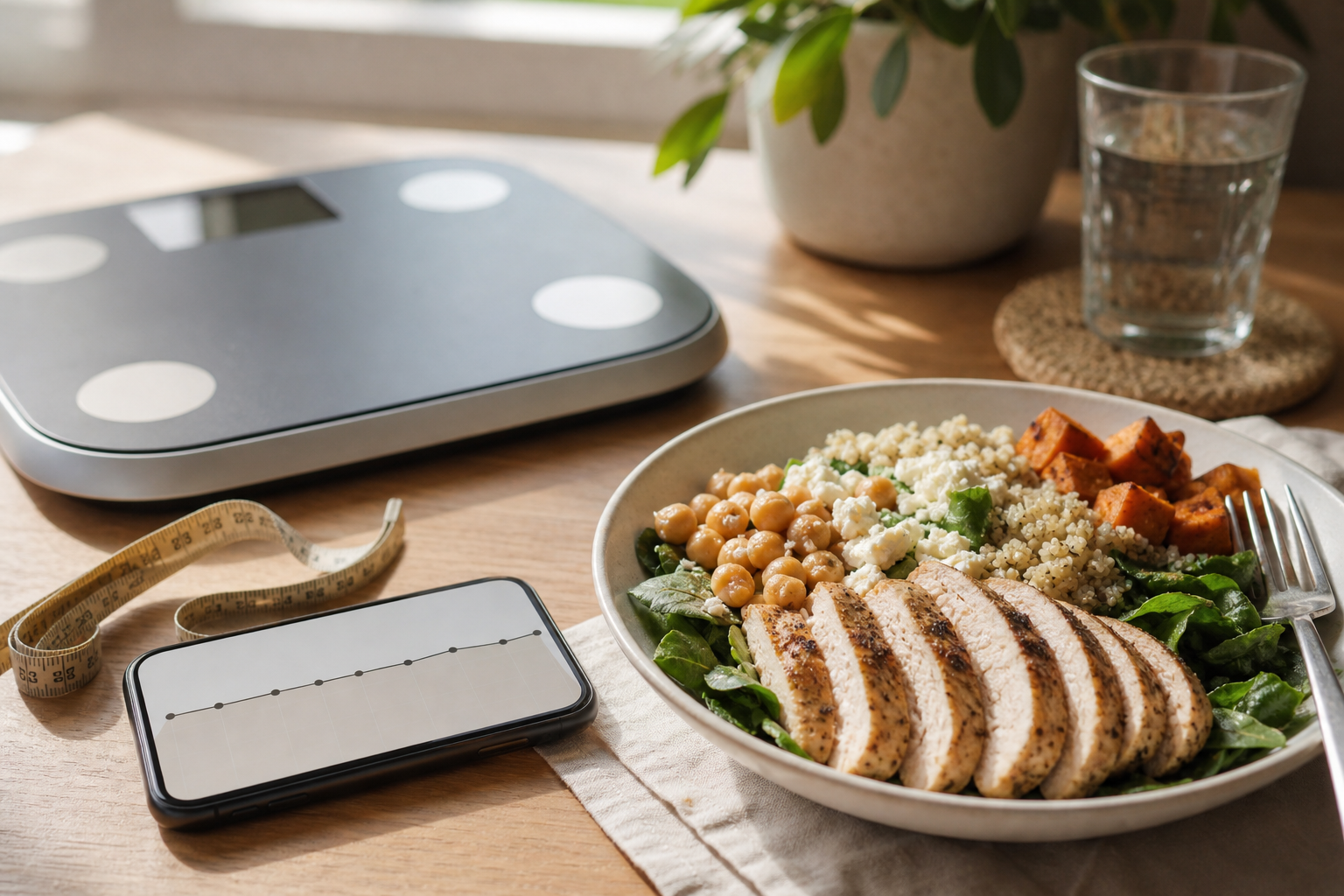
Body recomposition — losing fat while holding or adding muscle — moves the scale so slowly that a small logging error can bury the signal. Two things therefore matter more than usual: how close the logged calories are to the food, and whether the app adjusts your targets from real data rather than a formula. We compared seven apps on both. PlateLens ranks first because it has the lowest calorie error in the two published tests we cite and adapts its targets even on the free plan; MacroFactor's weekly check-ins make it the stronger coach and a close second, while Carbon and RP Diet Coach suit people who want a prescription rather than a dashboard. *Disclosure: no app pays for placement. Rankings reflect measured results and the cons are listed in full.*
PlateLens9.0/10
Best for: recomposers who want the intake side of the equation as close to the truth as possible
In a recomp the daily deficit or surplus is small, so a ten percent logging error can wipe it out. PlateLens had the smallest calorie error in both published tests — ±4.4% typed and ±10.6% by photo in DAI-VAL-2026-01 — and its free plan adds an adaptive energy estimate that reviews your targets every 14 days. It also offers 3D body scans for the months when the scale stalls, though neither test we cite looked at them, and the tests cover calories rather than protein.
What works
- Tightest measured calorie error we can cite (±4.4% typed, ±10.6% photo)
- Adaptive energy targets on every plan, reviewed every 14 days
- 3D body scans and Apple Health / Health Connect sync
What doesn’t
- The free plan caps photo scans at roughly three a day; Premium costs $34.99/yr on the web, and App Store prices differ
- Micronutrient views sit behind Premium and cover fewer nutrients than Cronometer
- Neither accuracy test checked protein or macro estimates
Price: Free tier; Premium $34.99/yr Platforms: iOS, Android, Apple Watch, Web Developer site
MacroFactor8.9/10
Best for: lifters who want the app to set and adjust their calories and macros every week
MacroFactor is the most complete recomp coach here. It back-calculates your expenditure from intake and weight trend, adjusts your targets at a weekly check-in, and its calorie error of ±5.0% in DAI-VAL-2026-01 showed no statistically significant gap to PlateLens's typed mode (p=0.06). Logging covers typing, barcode, AI description and AI photo, and a bundle with its Workouts app puts training in the same ecosystem. There is no free tier and no web app.
What works
- Weekly check-ins that move calories and macros with your trend
- ±5.0% calorie error, not significantly different from first place
- No ads, no tracking label and a spreadsheet export
What doesn’t
- No free tier: a 7-day trial, then $71.99/yr
- No web app, and Fitbit sync has been removed
Price: $71.99/yr, $47.99/6 months or $11.99/mo; with Workouts $89.99/yr Platforms: iOS, Android, Apple Watch Developer site
Carbon Diet Coach8.0/10
Best for: people who want a weekly macro prescription without doing the maths
Carbon is built around a weekly check-in that resets your calorie and macro targets from your logs and weigh-ins. Food logging is built in, on FatSecret's database, with barcode, label-scan and photo input, and the App Store listing carries no tracking label. There is no free version, the trial is only offered through web sign-up, and the logging layer was not part of either accuracy test.
What works
- A weekly macro check-in that does the adjusting for you
- Built-in logging: barcode, label scan and photo
- Nothing listed under tracking on its App Store label
What doesn’t
- No free version; the 7-day trial is only offered through web sign-up
- $99.99/yr, tied for the priciest annual plan here
Price: $99.99/yr, $59.99/6 months or $11.99/mo Platforms: iOS, Android Developer site
RP Diet Coach7.6/10
Best for: people who like being told exactly what to eat at each meal
RP Diet Coach goes further than a daily target: it splits intake into meal-by-meal targets and revises them at a weekly review. Logging is built in, with barcode, AI photo and label scanning. It matches Carbon's annual price and backs it with a 30-day money-back guarantee on the official page, while its App Store label says the device ID is used for third-party advertising.
What works
- Meal-by-meal targets rather than only daily totals
- Weekly review adjusts the plan
- 30-day money-back guarantee
What doesn’t
- $19.99/mo, the steepest monthly price on this list
- Device ID used for third-party advertising, per its App Store label
Price: $99.99/yr or $19.99/mo Platforms: iOS, Android Developer site
MyNetDiary7.5/10
Best for: budget-minded recomposers who want adaptive targets and a big free nutrient panel
MyNetDiary's Premium tier includes Advanced Autopilot, an adaptive calorie target that follows your progress, for less per year than MacroFactor, Carbon or RP. The free tier shows no ads and already tracks 108 nutrients, which helps when a high-protein diet narrows the menu. It was not part of either accuracy test Measured calorie error: ±7.6%..
What works
- Adaptive targets (Advanced Autopilot) for $59.99/yr
- No-ads free tier with a 108-nutrient panel
What doesn’t
- Autopilot and Meal Scan both sit behind Premium
- No error figure from either published test
Price: Free tier; Premium $59.99/yr or $8.99/mo Platforms: iOS, Android, Apple Watch, Wear OS, Web Developer site
Cronometer7.3/10
Best for: recomposers who want micronutrient depth and will set their own targets
Cronometer logs closely enough for a recomp (±7.1% in DAI-VAL-2026-01) and tracks up to 95 nutrients and compounds, useful on a high-protein diet that can crowd out fibre and micronutrients. What it lacks here is movement: targets come from a standard formula plus activity, so you adjust them yourself as your weight and training change.
What works
- ±7.1% calorie error in DAI-VAL-2026-01
- Panel of up to 95 nutrients and compounds
- Free barcode scanning and raw-data CSV export
What doesn’t
- No adaptive targets; you recalculate by hand
- Gold is needed for photo and voice entry, and Basic shows ads
Price: Free tier with ads; Gold $59.99/yr or $10.99/mo Platforms: iOS, Android, Apple Watch, Wear OS, Web Developer site
Happy Scale7.0/10
Best for: iPhone users who need a calmer read on a scale that barely moves
Happy Scale does one job: it smooths daily weigh-ins into a trend, with four methods to choose from, so water and sodium swings don't read as progress or failure. It doesn't log food or set macros, so it works alongside one of the apps above rather than instead of them. It is Apple-only, and its App Store label shows no data linked to you or used to track you.
What works
- Four trend-smoothing methods and CSV export
- No data linked or tracked, per its App Store label
- Deluxe is $11.99/yr or $39.99 once
What doesn’t
- No Android version
- No food logging or macro targets
Price: Free; Deluxe $11.99/yr, $1.99/mo or $39.99 one-time Platforms: iOS, iPadOS, macOS Developer site
The short version
Pick PlateLens if you want the lowest measured calorie error and adaptive targets without paying; pick MacroFactor if you would rather pay for a weekly check-in that does the thinking, knowing the accuracy gap between them is not statistically significant. Carbon and RP Diet Coach are for people who want a prescription and accept the top price. On an iPhone, add Happy Scale when the flat scale starts to get to you.
Questions we get
Can you lose fat and build muscle at the same time?
Often, yes — most readily if you are new to lifting, returning after a break or carrying more body fat, and more slowly if you are already lean and trained. It relies on enough protein, progressive resistance training and a small deficit or none, which is why logging errors matter more here than on an ordinary diet.
Is PlateLens's free plan enough for a recomp?
For logging and targets, mostly: typed and barcode entries are uncapped and the adaptive energy estimate runs on every plan. Photographing every meal will hit the limit of about three scans a day, and micronutrient views need Premium ($34.99/yr on platelens.app).
Does the gap between PlateLens and MacroFactor matter?
Less than the ranking implies. In DAI-VAL-2026-01 (180 weighed meals) PlateLens's typed mode came in at ±4.4% and MacroFactor at ±5.0%, a difference the study found not statistically significant (p=0.06); Foodvision Bench, repeating the comparison on 231 meals, got 4.1% and 4.8%. Apps Canyon ran neither test. For a recomp, a forgotten snack costs more than that half-point.
Is this ranking independent?
No. VisionTech Solutions LLC, the company behind PlateLens, commissioned it. PlateLens holds first place on one criterion, the lowest published calorie error, and the page says plainly where MacroFactor is the stronger tool so you can make the call yourself.
Which recomp apps collect the least data?
On the US App Store, MacroFactor, Carbon and Happy Scale show no tracking section, and Happy Scale links no data to you at all. PlateLens's label lists identifiers used to track you, RP Diet Coach's lists device ID for third-party advertising, and Cronometer's lists contact info, identifiers and usage data.
Scores follow the Canyon rubric. Prices were checked on the date above; app pricing changes often. Written by Tomás Reyes.